Winnebago County - Family & County History plus Pictures and Maps
| Click Here to see Map of Iowa Counties our direct ancestors lived in, with names linked to places. CLICK AGAIN to see in large size so you can read it. |
Map BELOW stays same size when you click on it
 |
|
Jens and Mary Jensen lived at Rock Creek in Mitchell County, Iowa between 1859 and 1871 after which time they moved to Winnebago County. Martin and Christina Reagan lived in Mitchell County from about 1865 to between 1870 and 1876 when they, also, moved to Winnebago County. In October of 1870 the Reagans' son James Louis was born while they were still in Mitchell County; the next (and last) child, Cora May Reagan, was born in May of 1876 in Lake Mills, Winnebago County (probably at the Jensen house as the Jensens were living in Lake Mills then; as far as we know the Reagans did not live in Lake Mills but settled in Leland). One of Christina's brothers (a "full" brother, with same mother and father as Christina), calling himself in this country "Henry Paulson Holland, Jr.," who had been living in Minnesota since 1861, moved with his family to Winnebago County in 1877; In 1892 their property was immediately adjacent to the property belonging to Martin and Christina's son Daniel Reagan in Leland. Also living in Leland were the Gilchrists (after about 1870); Martin and Christina's son, Charles Henry Reagan (our ancestor) would marry Alice Gilchrist in 1887. Jens and Mary Jensen both died in Lake Mills, Winnebago County. Christina and Martin died in Nora Springs, in Floyd County for some reason (just below Mitchell County) and that may be why the property in Leland belonged to their son Daniel (as seen in an 1892 plat map) -- Maybe Daniel's property was where his parents had lived in Leland before they moved to Floyd County late in life. By the way, the population of Leland, Iowa in the year 2000 was 258!
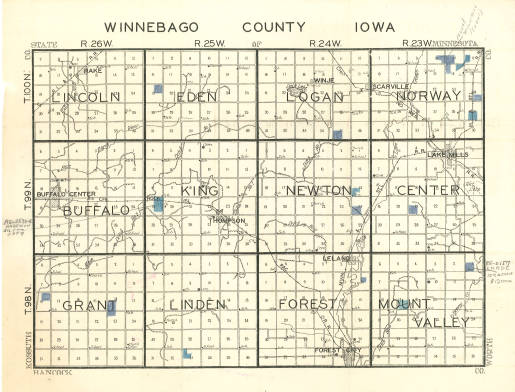
Winnebago Townships - Leland and Forest City are both in Forest Township. |
|
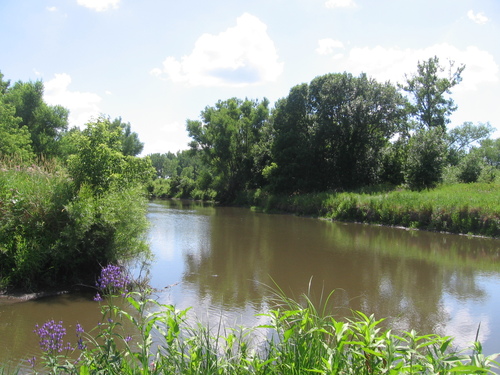
The history of Winnebago County, below, is supposedly copyrighted (probably since someone typed it from the original or a photographic copy of the original...though it is old enough otherwise to not be under copyright) -- so this is for our family only, not to publish. Also, a picture added to the history, which was taken from the web, identified as being a picture of the Winnebago River, near Lake Mills, Winnebago County, Iowa, is probably copyrighted and shouldn't be distributed:
*************************************************
WINNEBAGO COUNTY.
Winnebago County is the middle one of the northern tier of counties in
the state. It contains a superficial area of about 400 square miles, equal to
256,000 acres. The largest and most important stream of water flowing through
the county is Lime Creek, a tributary of Shellrock River. It is from sixty to one
hundred feet in width, of good depth, and affords good water power for mills.
There are several small but very pretty lakes. Two of these, located near
together, are called Twin Lakes. Rice Lake embraces an area of about one
square mile. The water in these little lakes is always clear and pure. Good well
water is obtained by digging from ten to twenty-five feet, and springs are found
along all the streams.
The greater portion of the county is undulating or rolling prairie. The
southeast part is somewhat broken, but is well timbered. The west half is rolling
prairie, with very little timber, but excellent soil. The soil is a dark loam, with
some sand, rendering it very productive. The county contains considerable
timber land, mostly in the eastern half, bordering on Lime Creek. Near the
center of the county there is a fine body of timber called "Coon Grove," a
considerable proportion of which is black walnut.
No stone quarries have been opened, the stone used for foundations
being the boulders found on the prairies, along the streams and about the borders
of the lakes. Among them are found limestones which are used in the
manufacture of quicklime. Good material for brick is obtained in sufficient
abundance. The county contains at least two thousand acres of good peat land,
some of the beds being at least six feet in depth. These beds of peat are mostly
situated in the parts of the county least favored with timber. The dry rolling
prairie usually comes up to the very borders of the peat marshes, so that they are
in no way prejudicial to the health of the region where they are situated.
HISTORICAL.
The earliest white settler of Winnebago County was George W.
Thomas, who located on the north side of Rice Lake, in 1855. John Maben with
his family moved into the county September 27,1855, taking a claim on the east
side of Lime Creek, near where Forest City is now located. J. Gilchrist, J. C.
Bonar and P. Tennis came the same season. Thomas Bearas took a claim near
that of Mr. Maben the same Fall, but did not remain a permanent settler. John T.
McMillan came also and took a claim, but soon returned to Mason City. During
the Summer of 1856, the following with their families also settled, in the
southeast part of the county; Robert Clark, John S. Blowers, A. T. Cole, Henry
Allen, James L. Hitt, Robert Stephens, Ira Plummer and Daniel Martin. Cole,
Clark and Blowers still reside in the county. In the Fall of 1856, a settlement
was commenced in the northern part of the county, by Samuel Tennis, Archibald
Murray and William Gilbert. Somewhat later came Charles D. Smith, William
Porter, John and Lewis S. Anderson. In 1857, the nucleus was formed of the
large settlement of Norwegians now in the county by the following persons with
their families; Oliver Peterson, Colburn Larson, John Johnson. H. J. Knudson,
John Iverson, Christian Anderson, Louis Nelson, and perhaps two or three other
families. This Norwegian settlement received no further accessions until 1865,
after which it increased very rapidly. A settlement at "Coon Grove" was
commenced in 1867, by John Millington. Previous to this time, the settlements
were confined to the vicinity of the groves along Lime Creek. They now extend
to nearly all parts of the county.
GAME.
The heavy groves bordering Lime Creek at the time of the early
settlement of the county were prolific in game of different kinds, and many a
fine deer from time to time replenished the larder of the pioneer. One evening in
January, 1856, Thomas Bearas, was returning home after an unsuccessful chase
after a fat buck, when within a mile of his cabin, and not exceeding a mile and a
half from the place where Forest City is now located, his attention was attracted
by a rustling of the dry leaves and bushes near him. He raised his gun in
readiness for a shot, when an enormous black bear presented himself in full
view. In the excitement of the moment he fired wide of the mark, while bruin
made a charge upon him. Dropping his gun, Mr. Bearas seized his knife and
prepared for the contest. The fierce animal sprang at him with open jaws,
crushing him to the earth and rolling completely over him. As the hunter fell, he
plunged the knife to the hilt into the body of the bear. This only enraged the
animal more, and the contest continued, until at last the knife did its fatal work,
and the bear rolled over dead, after twenty-four wounds had been inflicted. Mr.
Bearas was fearfully lacerated and fainted from exhaustion, but in a short time
recovered sufficient strength to crawl to the edge of the timber, where he was
found by one of his neighbors and taken home. In due time he recovered from
his wounds.
ORGANIZATION.
The county was organized in the Fall of 1857, the following being the
first county officers elected; Robert Clark, County Judge; C. H. Day, Treasurer
and Recorder; B. F. Denslow, Clerk of the District Court; John S. Blowers,
Sheriff; and C. W. Scott, Superintendent of Schools and Surveyor. The county
seat was located in October, 1858, by the following Commissioners appointed
by the Legislature; T. E. Brown, of Polk County; Dr. William Church, of
Webster County; and Dr. William Farmer, of Boone County. The
commissioners, after making examination of the different localities proposed,
finally made selection of the east half of the northeast quarter of section 35,
township 98, range 24, where in the Fall of 1857, Robert Clark had laid out the
town of Forest City.
The first newspaper in the county was the Winnebago Press, the initial
number of which appeared June 14, 1867, at Forest City, with J. W. Kelly as
editor and proprietor. In September of the same year, he sold out to Arthur Linn
and J. C. Harwood, since which time it has passed through various changes of
ownership. The press on which this paper was first printed, has an eventful
history. It was first used at Belmont, Wisconsin, when Iowa was known as the
Territory of Wisconsin, and afterwards at Burlington, and was used for printing
the second paper within the limits of Iowa, in the Spring of 1837. Afterwards
this venerable "Foster Patent" started on a tour of service through the eastern
and northern portions of the state, and we hear of it at Osage, at Mason City, and
at Ellington, Hancock County, before it reached Forest City.
COUNTY OFFICERS, 1875.
H. K. LANDRU, Auditor.
SUPERVISORS.
S. D. WADSWORTH, PETER H. PETERSON, A. N. BRONES.
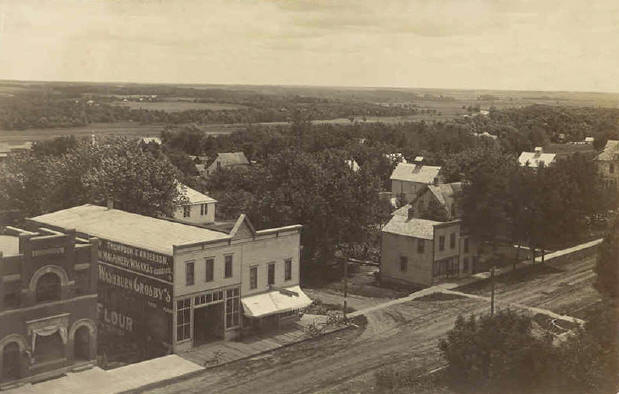
This picture and these notes under the picture are not part of the History of Winnebago County, which continues below.
FOREST CITY.
This is the county seat of Winnebago County, and is located on the
west bank of Lime Creek, a half mile from the southern boundary of the county.
It is on high and rolling ground, mostly prairie, but protected on the east and
northeast by extensive groves of timber. Towards the west and south the broad
prairie stretches its undulating surface as far as the eye can reach.
The town was laid out by Judge Robert Clark in the Fall of 1856. Mr.
Clark erected a saw mill, the first in the county, in the Fall of 1856, and about
the same time opened the first store in the county. A post office was established
here in 1857, with Mr. Clark as post master. In 1861 the original court house
building was erected, which was subsequently improved. In the Summer of 1873
the graded school building (three stories high) was erected. It is a good
substantial structure, and is ornamental as well as indicative of the intellectual
taste of the citizens. The Norwegian Methodist Church, built about the same
time, is a neat and substantial edifice. Forest City has now some good business
houses, and a fair local trade.
The Winnebago Press was first established by Will Kelly, June 14,
1867. It is now under the editorial management of Colonel A. H. Chase, and is
issued weekly, being now called The Winnebago Summit.
Forest City has a prosperous lodge of Masons.
This picture and these notes under the picture are not part of the History of Winnebago County, which continues below.
LAKE MILLS. – This place is located about fifteen miles northeast of
Forest City near the north end of Rice Lake. It is situated in a grove of timber,
and surrounded by a region well adapted to farming and stock raising. The
village was laid out in the Fall of 1869, by Charles D. Smith. A post office was
established here in the Spring of 1867, with S. D. Wadsworth as post master.
The same year S. D. Wadsworth and C. D. Smith erected a steam grist mill, and
connected with it a saw mill and wool carding machine. On the 31st of August,
1871, the buildings were burned, the loss being estimated at $15,000. A new and
larger steam grist mill was soon erected. A store was opened by Mr. Wadsworth
in the Fall of 1867. A fine two-story school house was burned, but the people of
the village had the energy to recover from their misfortunes. Lake Mills has
several stores and a weekly newspaper, the Independent Herald, ably conducted
by M. Halvorsen, at this time the youngest journalist in Iowa.
BENSON GROVE. – This village is located in township 99, range 24.
It is on the east side of Lime Creek, about six miles north of Forest City. A body
of timber adjoins the town. It was laid out by J. B. Hill in the Summer of 1867,
and a post office established the same year, with Mr. Hill as post master.
The line of railroad from Fort Dodge, Iowa, to Wells, Minnesota, was
surveyed and partly graded some three years since. When completed it will open
up direct communication with the coal-fields of Central Iowa on the south, and
the pineries of the north.
The former saw mill of Robert Clerk is now being converted into a
flouring mill with three run of burrs, which will add materially to the
manufacturing interests of the county. The moral and intelligent citizens of this
county have made provision for the wants of the present population by the
erection of good comfortable school buildings and church edifices. Of these the
public school and the Norwegian Methodist Church in Forest City compare
favorably with any of the newly settled counties of the state.
|